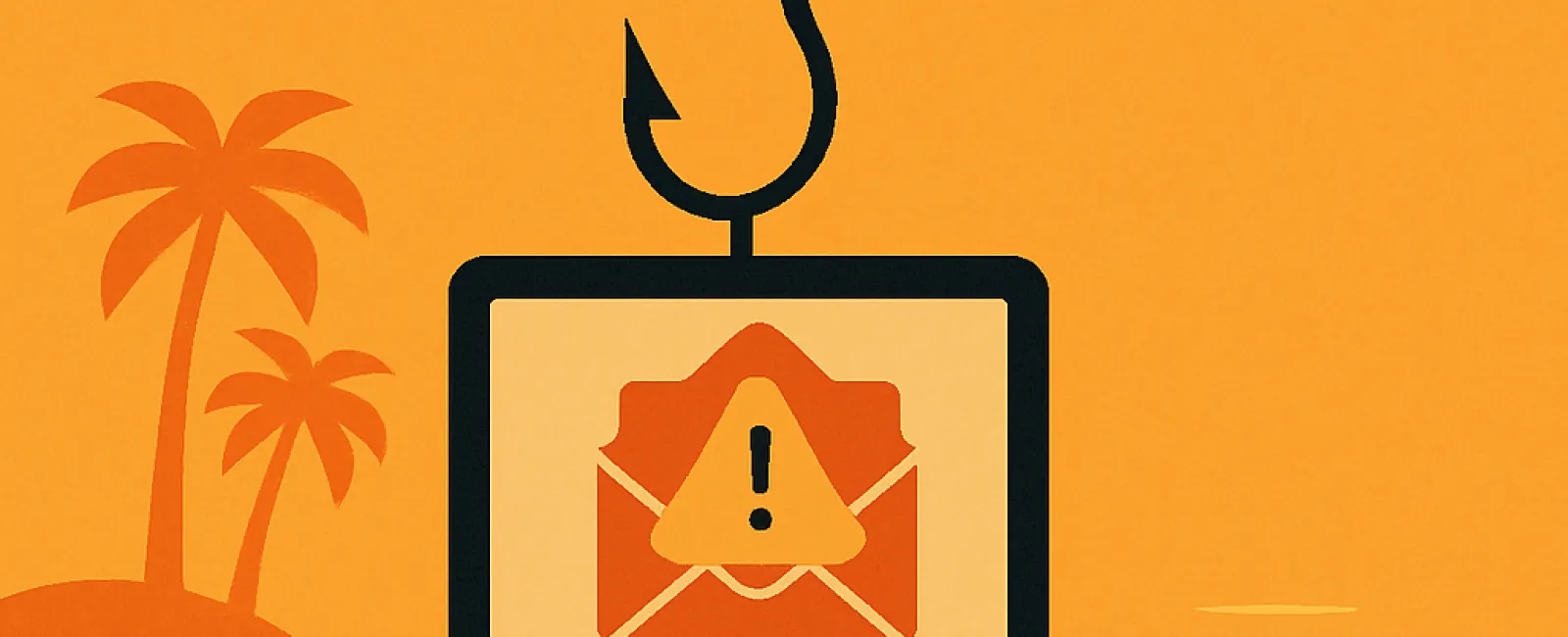
Summer might be winding down, but hackers? They're just getting started.
While you and your team are easing back from vacation, cybercriminals are
hard at work—because August is one of the busiest months for phishing attacks.
Here's what's happening, why it matters to your business, and how to stay
protected.
🚨 What's Behind the
Surge in Summer Phishing?
According to security researchers at ProofPoint and Check Point, phishing
attempts ramp up in the summer months, and the numbers don't lie.
Just this May, there was a 55% spike in new vacation-related
website domains compared to last year. Of those, nearly 1 in 21 was
flagged as malicious or suspicious.
Hackers are getting clever with how they bait their traps. Some examples
we're seeing:
- Fake Airbnb and hotel booking
confirmations
- Phony back-to-school emails from
"universities"
- Spoofed messages about summer
travel deals
Even if these scams don't target your industry directly, all it takes is one
employee checking a personal email on a work device, and suddenly, your
entire network is exposed.
🔍 So…What Can You Do?
The truth is, phishing emails have gotten a lot more believable, especially
now that AI is helping criminals write them.
That means your best defense isn't just spam filters or antivirus
software—it's awareness and proactive protection. Here's how:
✅ 1. Train Your Team to Spot the Signs
Don't rely on misspellings and awkward grammar to give away a scam
anymore. Today's phishing emails can look polished.
Make sure your team checks:
- Sender's email address
- Hover-over URLs
- Attachments or strange requests
✅ 2. Never Click Links—Go Direct Instead
If an email claims to be from your bank, airline, or university, go to
the website directly. Don't click links—type the URL yourself or use a bookmark
you trust.
✅ 3. Watch for Suspicious Domains
Scammers love domains that look close to the real thing. Look for odd
endings like .info, .today, or anything misspelled.
✅ 4. Enable MFA Everywhere
Multi-Factor Authentication adds a second layer of protection, even if
someone gets your password. App-based MFA is best.
✅ 5. Skip Personal Email on Work Devices
Mixing personal and business? That's how phishing gets a foothold. Keep
personal emails and apps on your personal phone or computer.
✅ 6. Use a VPN When Traveling
If you're on hotel WiFi or at an airport, always use a VPN to protect
your information.
✅ 7. Ask Your MSP About Endpoint Security
With Endpoint Detection & Response (EDR), your MSP can monitor
devices in real time and stop phishing attacks before they do damage. It's like
having a 24/7 security guard watching your digital front door.
🎯 Bottom Line:
Phishing Isn't Just a Nuisance, It's a Business Threat
These attacks are more advanced, more convincing, and more common than
ever, especially right now. That's why a well-trained team and strong
security tools aren't optional anymore. They're essential.
Let's make sure your business doesn't become another "it won't happen to
us" story.
🔐 Start the season secure—book your FREE Cybersecurity Assessment today— click here or call us at (805) 295-8883 to schedule your FREE 10-Minute Discovery Call today.